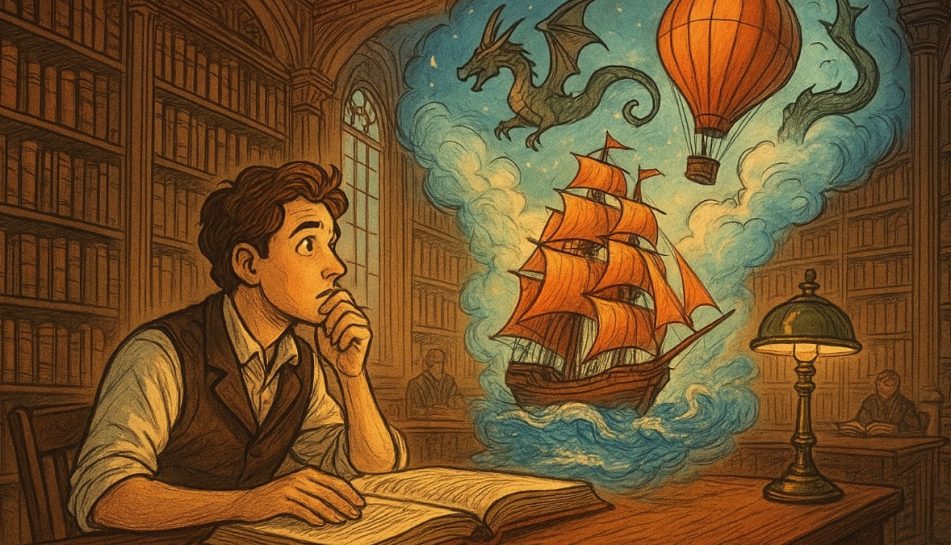
Do you have a visual imagination?
Thinking and remembering visually are useful faculties I’ve always taken for granted and assumed were more or less common to everyone. However, a number of recent conversations with friends have revealed that some people are wired without any visual imagination at all.
For people who aren’t able to voluntarily create mental images — apparently a condition called aphantasia — visual descriptions and metaphors have little or no utility. Ask someone with aphantasia to picture a rosy red apple, for instance, and the image of a tempting fruit won’t appear in their mind’s eye. They won’t see it.
As well as wondering why it’s taken me so long to become aware of aphantasia, I’m fascinated by the implications the phenomenon has for writers and storytellers in particular, and for communicators in general.
A little initial reading around the topic immediately highlights that the term aphantasia was coined in 2015 by Professor Adam Zeman of the University of Exeter. An article about his work from a couple of years ago points out that aphantasia “is thought to affect around one per cent of the population, while three per cent are hyperphantasic.”
Research indicates that aphantasia is not a single entity, but has subtypes. For example, not everyone with aphantasia has a poor autobiographical memory or difficulty in recognising faces, and in a minority of people, aphantasia appeared to be linked to autism. People who cannot visualise are more likely to have scientific occupations. Unexpectedly, although people with aphantasia can’t visualise at will, they often dream visually.
‘I can’t picture things in my mind. I didn’t realize that was unusual’ by Shayla Love in the Guardian references Zeman’s research and offers some insight into her own experience:
I can remember visual details, just not visually. I can rattle off what a person was wearing or what a scene looked like by remembering a list of what was there, not by seeing it. Mostly, I remember how experiences felt – emotionally and physically. I’m best at remembering concepts and themes from books or conversations.
As an author of historical fiction, I’m especially interested in how different storytelling styles might be compatible with aphantasia. Generalising somewhat, it seems that dialog-driven, action-oriented narratives with character-centred and sensory-diverse narration tend to give non-visual thinkers the most impactful reading experience.
If you’re aphantasic, or believe you might be, please do share in the comments (or via a more private message if you prefer) how you engage with visual descriptions and metaphors. If you’re a writer I’d be interested to know if you were already aware of aphantasia and taking it into account in your work, of if you now intend to in the future.